header

venerdì 25 marzo 2016

LIVER OF PIACENZA

The Liver of Piacenza is an Etruscan artifact found in a field on September 26, 1877, near Gossolengo, in the province of Piacenza, Italy, now kept in the Municipal Museum of Piacenza, in the Palazzo Farnese.

It is a life-sized bronze model of a sheep's liver covered in Etruscan inscriptions (TLE 719), measuring 126 mm by 76 mm by 60 mm and dated to the late 2nd century BC, i.e. a time when the Piacenza region would already have been Latin-dominated (Piacenza was founded in 218 BC as a Roman garrison town in Cisalpine Gaul).

The liver is subdivided into sections for the purposes of performing haruspicy (hepatoscopy); the sections are inscribed with names of individual Etruscan deities. The Piacenza liver is a striking conceptual parallel to clay models of sheep's livers known from the Ancient Near East, reinforcing the evidence of a connection (be it by migration or mere cultural contact) between the Etruscans and the Anatolian cultural sphere. A Babylonian clay model of a sheep's liver dated to the Middle Bronze Age is preserved in the British Museum (ME 92668). The Piacenza liver parallels the Babylonian artefact by representing the major anatomical features the gall bladder, caudate lobe and posterior vena cava, of the liver as sculpted protrusions.

The outer rim of the Piacenza liver is divided into 16 sections; since according to the testimony of Pliny and Cicero, the Etruscan divided the heavens into 16 astrological houses, it has been suggested that the liver is supposed to represent a model of the cosmos, and its parts should be identified as constellations or astrological signs. Each of the 16 houses was the "dwelling place" of an individual deity. Seers would e.g. draw conclusions from the direction in which lightning was seen. Lightning in the east was auspicious, lightning in the west inauspicious (Pliny 2.143f.). Stevens (2009) surmises that Tin, the main god of lightning, had his dwelling due north, as lightning in the north-east was most lucky, lightning in the north-west most unlucky, while lightning in the southern half of the compass was not as strong an omen (Servius ad. Aen. 2.693).

The theonyms are abbreviated and in many cases, the reading even of the abbreviation is disputed. As a result, there is a consensus for the interpretation of individual names only in a small number of cases. The reading given below is that of Morandi (1991) unless otherwise indicated:

circumference:

1. tin[ia] /cil/en
2. tin[ia]/θvf[vlθas]
3. tins/θneθ
4. uni/mae uni/ea (Juno?)
5. tec/vm (Terra)
6. lvsl
7. neθ[uns] (Neptunus)
8. caθ[a] (Luna?[3])
9. fuflu/ns (Bacchus)
10. selva (Silvanus)
11. leθns
12. tluscv
13. celsc
14. cvl alp
15. vetisl (Veiovis?)
16. cilensl
interior:

17. tur[an] (Venus)
18. leθn (as no. 11)
19. la/sl (Lares?)
20. tins/θvf[vlθas] (as no. 2)
21. θufl/θas
22. tins/neθ (as no. 3?)
23. caθa (as no. 8)
24. fuf/lus (as no. 9)
25. θvnθ(?)
26. marisl/latr
27. leta (Leda)
28. neθ (as no. 7)
29. herc[le] (Hercules)
30. mar[is] (Mars)
31. selva (as no. 10)
32. leθa[m]
33. tlusc (as no. 12)
34. lvsl/velch
35. satr/es (Saturnus)
36. cilen (as no. 16)
37. leθam (as no. 32)
38. meθlvmθ
39. mar[is] (as no. 30)
40. tlusc (as no. 12)
Two words are on the bottom side of the artefact:

1. tivs (or tivr "Moon"?[1])

2. usils


venerdì 22 maggio 2015

SARCOPHAGOUS OF THE SPOUSES

An example of terracotta sculpture from Caere.


The Sarcophagus of the Spouses was found in 1845 by the Marquis Campana in the Banditaccia necropolis in Caere (modern Cerveteri). Purchased in 1861 by Napoleon III, this monument has often been regarded as a sarcophagus because of its exceptional dimensions. However, its function remains uncertain because burial and cremation were both practiced by the Etruscans. It may actually have been a large urn designed to contain the ashes of the deceased. Only one example similar to this work is known (Museo Nazionale Etrusco di Villa Giulia, Rome), which also demonstrates the high level of skill attained by the sculptors of Caere in clay sculpture during the late 6th century BC.
During the Archaic period, terracotta was one of the preferred materials in the workshops of Caere for funeral monuments and architectural decoration. The ductility of clay offered artisans numerous possibilities, compensating for the lack of stone suitable for sculpture in southern Etruria.


Funerary banquet and ritual.


This urn takes the form of a bed, upon which the deceased are resting in the position of banqueters. This theme was not an Etruscan invention, but originated in Asia Minor: the Etruscans, like the Greeks before them, had adopted the eastern custom of feasting in a reclining position, and the conventional method of representing it. Unlike in the Greek world, where banquets were reserved for men, the Etruscan woman, who held an important place in society, is represented by her husband's side, in the same proportions and in a similar pose. The couple are reclining on cushions in the form of wineskins, a reference to the sharing of wine, a ceremony that was part of funerary ritual. Tenderly clasped by her husband, the deceased woman is pouring a few drops of perfume into his hand, probably from an alabastron, as can be seen on a small urn displayed nearby (cinerary urn with the spouses on the lid, Louvre, CP 5193); in so doing, she is making the gesture of offering perfume, another essential component of funerary ritual. In her left hand she is holding a small, round object, possibly a pomegranate, a symbol of immortality.

The influence of eastern Greece


The style of this monument shows the influence exerted by artists from eastern Greece on Etruscan art-particularly the Ionians, who emigrated in large numbers during the late 6th century BC. The casket and the lid are decorated with bright paintwork, now partially disappeared, which adds to the elegance of the woman's finery, and to the details of the fabrics and the hair. The smiling faces and full forms of the bodies are also inspired by Ionian sculpture. However, some of the features are typical of Etruscan art, such as a certain lack of formal coherence, the way the legs in particular have received less plastic volume, and the emphasis on the gestures of the deceased.


giovedì 29 gennaio 2015

ETRUSCAN MYTHOLOGY: CHARUN

In Etruscan mythology, Charun (also spelled Charu, or Karun) acted as one of the psychopompoi of the underworld (not to be confused with the lord of the underworld, known to the Etruscans as Aita). He is often portrayed with Vanth, a winged goddess also associated with the underworld.


Origins.
His name was imported from Greek Charon, although it is uncertain whether Etruscans had a native name for a god of the underworld before this. As suggested by alternations in the Etruscan language such as θu "one" changing to θunśna "first", lev "lion" (from Greekleōn) and Apulu (from Greek Apóllōn), words ending in -n after u were disappearing from the language which is why we see his name spelled Хarun and later Хaru.
Appearance.
The Etruscan Charun was fundamentally different from his Greek counterpart. Guarding the entry to the underworld he is depicted with ahammer (his religious symbol) and is shown with pointed ears, snakes around his arms, and a blueish coloration symbolizing the decay of death. In some images he has enormous wings. He is also depicted as a large creature with snake-like hair, a vulture's hooked-nose, large tusks like a boar, heavy brow ridges large lips, fiery eyes, pointed ears a black beard, enormous wings, discolored (pale cream, bluish or grey skin, and snakes around his arm.


Function.
Larissa Bonfante and Judith Swaddling have this to say about Charun: "Many scenes feature the two purely Etruscan underworld demons, Vanth and Charu, whose job is not to punish the dead but rather to escort them to their final destination."However, there are at least two examples, on the sarcophagus of Laris Pulenas as well as a red figure stamnos from Orbetello, that do illustrate Charun in a menacing fashion. Each depicts Charun threatening a male figure with his hammer.
The grotesque nature of the depiction of Charun appears to have been at least partly apotropaic in nature. Apotropaic art was the practice of the neighboring Greeks at this time, as represented by the exaggerated eyes painted on drinking vessels in the 6th century BC to ward away spirits while drinking or the monstrous depiction of Medusa whose image was said to turn men to stone. Through these images of the grotesque, violence and blood-letting, the Etruscans may have believed that they helped to fend off evil spirits from the tomb as well as sanctify the tomb perhaps in place of the actual ritual sacrifice of an animal usually performed in funerary rites.
Nancy de Grummond offers a different view. The relief on the sarcophagus of Laris Pulenas at Tarquinia, shows two Charuns swinging their hammers at a person's head, though the head (probably that of Pulenas, the nobleman whose sarcophagus it is) no longer survives in the relief due to an accident of preservation. Years later, in the Colosseum, a Charun-like figure called Dispater would hit the loser with a hammer to make sure he was dead, perhaps in reflection of Charun. The hammer might also be used to protect the dead; it is sometimes swung at serpents attacking the deceased (as shown on the Orvieto amphora). Most often it is simply held, or the handle planted on the ground and the mallet head leaned upon (above). De Grummond notes that the ferry of Charon appears only once in surviving Etruscan art, and that some Etruscan demons are equipped with oars, but they typically use them as weapons rather than in their maritime function.


Modern views.
Many authors tend to take a more sensationalist view of Charun, speaking of him as a "death-demon". Such authors may be inspired by Christian views of Hell and moral punishment. For the Etruscans, as with the Greeks, Hades was merely a morally neutral place of the dead. Neither the "good" nor the "bad" could escape the clutches of death and both were assembled there together.
Ron Terpening, a professor of Italian literature at the University of Arizona, cites Franz de Ruyt, who claims Charun is similar to Chaldean demons or the Hindu divinities Shivaand Kali. He is presumed to be the servant of Mantus and Mania, and, like Charon, is comparable to the Greeks' Thanatos, the Erinyes, and the Keres. The author, like de Grummond, feels that some later Renaissance paintings of Greek Charon may show the continuity of pre-Christian Etruscan beliefs. Later on when the deity had evolved into the Greek Charon, or Caronte in Italian, Terpening notes that Charun's hammer or mallet is sometimes replaced with an oar, although it does not fit with his duties.
According to Jeff Rovin, Charun guided souls on horseback to the underworld and "brings horses to the newly-dead", but this is idle speculation. He also claims that Charun appears to love violence and participates in warfare adding that Charun enjoys natural disasters as well. An Etruscan krater from François Tomb (above) depicts Charun withAjax or Achilles (left, cropped out) slaughtering Trojan prisoners. This urn is currently held in Cabinet des Médailles 920, Bibliothéque Nationale, Paris. Rovin says that some accounts depict him with a sword, and that he "slices" souls with it. At least one image shows him guiding a soul on horseback, equipped with both a hammer and a sword, though he is simply carrying it on his person.
The Charon of Vergil in the Aeneid is particularly cruel; according to W.F. Jackson Knight, "Vergil's Charon is not only the Greek ferryman of Aristophanes [in The Frogs], but more than half his Etruscan self, Charun, the Etruscan torturing death-devil, no ferryman at all."


Assistants.
Charun is believed to have worked with many assistants in the Underworld, although they could be independent deities in their own right. Most of their names are lost to us, but at least one, Tuchulcha, is identified in the Tomb of Orcus II, and has hair and wings like a Gorgon. Tuchulcha, whose gender is debated among scholars, appears in a depiction of the story of Theseus (known to the Etruscans as "These") visiting the underworld. These and his friend Peirithous are playing a board game, attended by Tuchulcha.
There are four Charuns shown in a fresco in the Tomb of the Charuns, and each appear to have sub-names. These are Charun Chunchules, the heavily blistered Charun Huths, Charun Lufe, and the fourth has crumbled away to illegibility. On Laris Pulena's sarcophagus, there are also two Charuns and two Vanths on either side of the figure in the center who is presumably Laris Pulena himself. De Grummond does not cite these figures as assistants, but believes Charun may be a type of creature rather than a singular god.

Many of Charun's other presumed assistants appear in the Tomb of the Blue Demons, which is also the home of the only Etruscan rendering of the aforementioned ferry of Charon.


venerdì 14 novembre 2014

MONTAGNOLA TOMB AND MULA TOMB

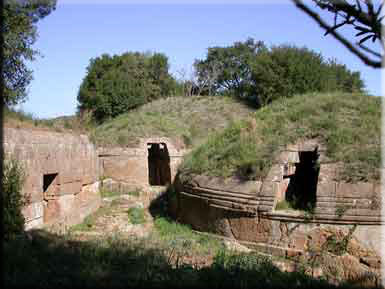
In the Quinto Alto locality are still to be found two of the most important Etruscan architectural monuments: the great tholos tombs (with false cupola) of Montagnola and Mula. They owe their fame to the splendid state of conservation of the structures, which bear witness, for the orientalizing age (7th century B.C.), to the utilisation of an architectural technique similar to that of the monumental tombs at Mycenae, among them the so-called Treasure of Atreus.

As compared to other false-cupola tombs – those of Populonia, for instance – these tombs differ not only in the circular layout of the main chambers, but above all in their remarkable size: a diameter of 5 metres for the Montagnola Tomb, over 8 for that of Mula, dimensions involving notable technical difficulties as regards construction and stability.

The Montagnola Tomb appears as a tumulus with diameter of nearly 70 meters, originally bounded by blocks of clay-rich limestone and waterproofed by a layer of clay. It is entered through an open dromos (corridor) leading to an inner corridor with pseudo-vault, on either side of which are two small rectangular cells. A narrow ogive door opens into the main chamber, which is covered by rows of progressively projecting slabs of stone resting on a vertical socle 3 meters high. The summit is closed by a square slab supported by a pilaster, which, however, does not seem to have a true static function.

Entirely without a central support is the great tholos of the Mula Tomb, which was incapsulated in the sixteenth-century Villa Garbi Pecchioli to be used as a wine-cellar. With part of its dromos demolished on that occasion, it differs from the Montagnola Tomb in that it has no socle in the chamber. Perhaps constructed by the same workers as the other tomb, it boasts the largest cupola known as of now in pre-Roman Italic architecture.

The Montagnola Tomb

The Mula Tomb

giovedì 13 novembre 2014

LIBER LINTEUS

The Liber Linteus Zagrabiensis (Latin for "Linen Book of Zagreb", also rarely known as Liber Agramensis, is the longest Etruscan text and the only extant linen book, dated to the 3rd century BC. It remains mostly untranslated because of the lack of knowledge about the Etruscan language, though the few words which can be understood indicate that the text is most likely a ritual calendar.
The fabric of the book was preserved when it was used for mummy wrappings in Ptolemaic Egypt. The mummy was bought in Alexandria in 1848 and since 1867 both the mummy and the manuscript have been kept in Zagreb,  now in a refrigerated room at the Archaeological Museum.

History of discovery
In 1848, Mihajlo Barić (1791–1859), a low ranking Croatian official in the Hungarian Royal Chancellery, resigned his post and embarked upon a tour of several countries, including Egypt. While in Alexandria, he purchased a sarcophagus containing a female mummy, as a souvenir of his travels. Barić displayed the mummy at his home in Vienna, standing it upright in the corner of his sitting room. At some point he removed the linen wrappings and put them on display in a separate glass case, though it seems he had never noticed the inscriptions or their importance.
The mummy remained on display at his home until his death in 1859, when it passed into possession of his brother Ilija, a priest in Slavonia. As he took no interest in the mummy, he donated it in 1867 to the State Institute of Croatia, Slavonia, and Dalmatia in zagreb .
In 1891, the wrappings were transported to Vienna, where they were thoroughly examined by Jacob Krall, an expert on the Coptic language, who expected the writing to be either Coptic, Libyan or Carian. Krall was the first to identify the language as Etruscan and reassemble the strips. It was his work that established that the linen wrappings constituted a manuscript written in Etruscan.
At first, the provenance and identity of the mummy were unknown, due to the irregular nature of its excavation and sale. This led to speculation that the mummy may have had some connection to either the Liber Linteus or the Etruscans. But a papyrus buried with her proves that she was Egyptian and gives her identity as Nesi-hensu, the wife of Paher-hensu, a tailor from Thebes.

Date and origin
On paleographic grounds, the manuscript is dated to approximately 250 BC. Certain local gods mentioned within the text allow the Liber Linteus's place of production to be narrowed to a small area in the southeast of  Tuscany near Lake Trasimeno, where four major Etruscan cities were located: modern day Arezzo, Perugia, Chiusi and cCortona.

Structure
The book is laid out in twelve columns from right to left, each one representing a "page". Much of the first three columns are missing, and it is not known where the book begins. Closer to the end of the book the text is almost complete (there is a strip missing that runs the entire length of the book). By the end of the last page the cloth is blank and the selvage is intact, showing the definite end of the book.
There are 230 lines of text, with 1200 legible words. Black ink has been used for the main text, and red ink for lines and diacritics.
In use it would have been folded so that one page sat atop another like a codex, rather than being wound along like a scroll. Julius Caesar is said to have folded scrolls in similar accordion fashion while on campaigns.

Content
Though the Etruscan language is not fully understood, certain words can be picked out of the text to give us an indication of the subject matter. Both dates and the names of gods are found throughout the text, giving the impression that the book is a religious calendar. Such calendars are known from the Roman world, giving not only the dates of ceremonies and processions, but also the rituals and liturgies involved, the lost Etrusca disciplina referred to by several Roman antiquarians.

The theory that this is a religious text is strengthened by recurring words and phrases that are surmised to have liturgical or dedicatory meanings. Some notable formulae on the Liber Linteus include a hymn-like repetition of ceia hia in column 7, and variations on the phrase śacnicstreś cilθś śpureśtreśc enaś, which is translated by van der Meer as "by the sacred fraternity/priesthood of cilθ, and by the civitas of enaś".


mercoledì 16 ottobre 2013

The Monteleone Chariot

The Monteleone chariot is an Etruscan chariot  dated to c. 530 BC. It was originally uncovered at Monteleone di Spoleto and is currently part of the collection of the Metropolitan Museum of Art in New York City. Though about 300 ancient chariots are known to still exist, only six are reasonably complete, and the Monteleone chariot is the best-preserved and most complete  of all known surviving examples. Carlos Picón, curator of the museum's Greek and Roman department, has called it "the grandest piece of sixth-century Etruscan bronze anywhere in the world."

The Monteleone chariot was part of a burial, containing the remains of two human corpses, along with two drinking cups. Measuring 131 cm in height and designed to be drawn by two horses, the chariot itself is constructed of wood covered with hammered bronze plates and carved ivory decoration. The bronze plates are decorated with Homeric iconography; the main panel depicts Achilles being handed his armor by his mother, Thetis. The chariot's frame and plating is additionally adorned with animals and mythological creatures, rendered in detail. The chariot's decorations would also have included inlaid amber and other exotic materials, but only the bronze and ivory decorations have survived. The chariot's wheels have nine spokes (rather than the classical Greek four, the Egyptian six, or the Assyrian and Persian eight; excavated chariots from Celtic burials have up to twelve spokes).

Contemporary curators at the Museum had long suspected that the chariot's original 1903 reconstruction was not historically accurate. In 1989, under the direction of Italian archaeologist Adriana Emiliozzi, the Metropolitan Museum began a five-year reexamination and restoration of the chariot. During the restoration, it was discovered that the chariot had in fact been originally assembled incorrectly; additionally, evidence was uncovered indicating that the chariot, previously thought to have seen little actual use, had in fact been involved in a serious accident at some point during its life. The newly restored chariot's reinstallation was scheduled as part of the major renovations of the Metropolitan Museum's Greek and Roman galleries, opening to the public on April 20, 2007.

It was found in 1902 in Monteleone di Spoleto near Spoleto in the province of Perugia of Umbria, by a farmer named Isidoro Vannozzi who inadvertently unearthed it while digging a wine cellar. According to some accounts, Vannozzi hid the chariot in his barn, concerned that the authorities might confiscate it, and later sold it to two Frenchmen in exchange for two cows. Another account, related by Vannozzi's son Giuseppe, holds that the chariot was immediately sold as scrap metal, and the proceeds from the sale used to buy roof tiles. Changing hands several times after its initial sale, the chariot was eventually purchased in Paris by J. P. Morgan, who sent it to the Metropolitan Museum in 1903, where its first restoration took place.

Because the museum's acquisition of the chariot in 1903 predates by six years Italy's first laws restricting export of items that carry "cultural and artistic values," the chariot's sale was legal at the time of purchase, though debated by the contemporary press. In January 2005, the comune of Monteleone began a campaign aimed at recuperating the chariot from the Met; their efforts, however, did not receive the backing of the Italian government. The Metropolitan Museum has responded that the chariot was "purchased in good faith".A full-size copy was made in the mid-20th century, which is on display in Monteleone.


mercoledì 18 settembre 2013

Fortified Settlement of Ghiaccioforte - 3 - Votive Offering

The discovery of votive offerings on the western hill of Ghiaccioforte testifies to the existence of a place of worship. In fact, it was an ancient custom to leave votive offerings near a sanctuary, which steadily accumulated.

The objects retrieved in the cache of votive offerings of Ghiaccioforte, preserved in the museum of Scansano, are mostly reproductions of parts of human anatomies, placed there to ask the divinity for the healing of an illness, or as thanks for a past healing.

The presence of two bronze statuettes, representing youths grasping a billhook, offers some indication of the kind of worship practiced in this place: it was probably connected to the agricultural activities of the area, as the iconography of the two statuettes would lead us to believe; they probably represent Selvans, typical Etruscan rural gods.


giovedì 5 settembre 2013

Fortified Settlement of Ghiaccioforte - 2 (Scansano - Gr)

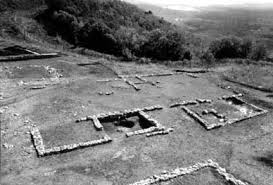
The settlement was built up within the city walls: some spaces were brought to light that made up part of the only living complex, where rooms were distributed around an open-air courtyard.

At the present time, all that is visible is the skirting foundations of the walls formed by a plinth of calcareous rock, while the raised portion, none of which has been preserved, was probably made of unbaked clay.

The floor was made of simple beaten earth or pebbles, whereas the roof was made of bricks and tiles as proven by the fragments of bricks recovered.

Based on the objects found inside, the various functions of some rooms can be identified.

In particular, the finding of an oven, derived from half of a dolium, cut vertically and placed on the ground, and the presence of a cooker, inserted into a niche dug into the inner wall, leads us to believe that the room, from whence these objects came, was used as a kitchen.

The corner of the bath can be identified by the furnishings composed of a terracotta basin and a bathtub derived from a block of decorated stone, both of which are preserved in the museum of Scansano.

In order to construct the tub, a copy of which can still be seen on site, an altar coming from the area of worship was probably reused; the area of worship presumably rose here in antiquity before the settlement of the Roman era.

One space, which was isolated to date with respect to the others, contained large doliums used for preserving foodstuffs: thus, its function was most likely that of a pantry.

The settlement restored many finds in ceramic: crockery and glassware for use at table and containers for preserving food. In addition, the presence of tongs, perhaps from a forger, and finished products, like weapons, indicate local metallurgical manufacturing.

martedì 3 settembre 2013

Fortified Settlement of Ghiaccioforte (Scansano - Gr)

Established in the 4th century B.C., the fortified settlement of Ghiaccioforte rose in the valley of Albegna, in the territory controlled by the ancient Etruscan city of Vulci.

The place chosen probably hosted a sanctuary, in antiquity, and previous settlers were housed in the homes scattered on the surrounding hills.

Its position was strategically placed for controlling and defending the Vulci territory in an era in which the pressure from Rome was becoming increasingly forceful in a general climate of political instability.

The end of the settlement of Ghiaccioforte was ultimately marked by the Roman conquest of the Etruscan city of Vulci and its surroundings in 280 B.C.

Once having settled there, the conquerors proceeded to reorganise the territory: new cities were built, such as Cosa (Ansedonia), but pre-existing sites, such as Saturnia and the settlement of Ghiaccioforte were also destroyed; the latter was never reconstructed. After the destruction, the location was intermittently inhabited, while the settling of new Roman farms changed the landscape of the surrounding hills.

Having been deserted and no longer occupied by a stable settlement, the environs reverted to pastureland over time. The name given to it today probably alludes to the destroyed fortified centre and the use the location had thereafter: ghiaccio from "addiaccio" (pen – shelter for the herd at night) and forte (fort) to indicate the remains of the Etruscan walls that never completely disappeared from view.


venerdì 9 agosto 2013

Tomb of the Winged Demons in Sovana

The Tomb of the Winged Demons of Sovana, discovery in the 2005, is the one of the most significant example of the tombs in the necropoli of Felceto in sovana. The tomb looks like a cubic block carved into the tufa, whose face is carved on the face of a building to a kiosk, characterized by a deep central room. Within this niche is represented a dead man lying in bed with a friendly libation in his right hand, which keeps intact the special polychrome finish. The sculpture preserves the covering of stucco and colors, red for exposed parts,  whitefor  tunic and mantle.

At the sides of the central niche originally stood two statues of winged female demons, of which only that on the left, with the torch, is quite well preserved. On the pediment, in high relief, stands a majestic, winged sea demons. In symmetrical positions, in front of the facade, were two sculptures in the round were placed on high podiums, only that on the left, depicting a lion, is fairly well conserved.


mercoledì 17 luglio 2013

Necropolis of the Banditaccia, (Cerveteri).

The most famous attraction of Cerveteri is the Necropoli della Banditaccia, which has been declared by UNESCO a World Heritage Site together with the necropoleis in Tarquinia. It covers an area of 400 ha, of which 10 ha can be visited, encompassing a total of 1,000 tombs often housed in characteristic mounds. It is the largest ancient necropolis in the Mediterranean area. The name Banditaccia comes from the leasing (bando) of areas of land to the Cerveteri population by the local landowners.
The tombs date from the 9th century BC (Villanovan culture) to the late Etruscan age (3rd century BC). The most ancient ones are in the shape of a pit, in which the ashes of the dead were housed; also simple potholes are present.
From the Etruscan period are two types of tombs: the mounds and the so-called "dice", the latter being simple square tombs built in long rows along "roads". The visitable area contains two such "roads", the Via dei Monti Ceriti and the Via dei Monti della Tolfa (6th century BC).
The mounds are circular structures, and the interiors, carved from the living rock, house a reconstruction of the house of the dead, including a corridor (dromos), a central hall and several rooms. Modern knowledge of Etruscan daily life is largely dependent on the numerous decorative details and finds from such tombs. The most famous of these mounds is the so-called Tomba dei Rilievi (Tomb of the Reliefs, 3rd century BC), identified from an inscription as belonging to one Matunas and provided with an exceptional series of frescoes, bas-reliefs and sculptures portraying a large series of contemporary life tools.
The most recent tombs date from the 3rd century BC. Some of them are marked by external cippi, which are cylindrical for men, and in the shape of a small house for women.

A large number of finds excavated at Cerveteri are in the National Etruscan Museum , with others in the Vatican Museums and many other museums around the world. Others, mainly pottery, are in the Archaeological Museum at Cerveteri itself.


giovedì 11 luglio 2013

The Sancturary of Portonaccio (Veii)

The site.

The site is a polytheistic temple complex erected in a cutting on the side of the hill on which the city wall of Veii towered over it then. One of the richest sources of Etruscan artifacts: pottery and other objects inscribed in Etruscan and terra cotta statuary and other decorative elements, it contained two main structures, one a sanctuary dedicated to the goddess Menerva(Etruscan spelling) and the other a temple that had statues of Turms, Hercle, Aplu (the Apollo of Veii) and Letun on the roof, which has come to be regarded as a temple of Apollo. Next to the temple of Apollo was a rectangular pool. A well provided water. The site has been left wooded, as it was in ancient times, when surrounded by a sacred grove.
The site was excavated in modern times by Massimo Pallottino in the 1940s and published decades later by the first and second generation of his students. The roof of the temple of Apollo has been restored on one side. It hangs over the site on a geometrical framework of steel rods. The sanctuary of Menerva is under roof nearby. Otherwise, only the foundation walls of the complex survive. In ancient times, it was surrounded by its own wall.


The sanctuary to Minerva.

The Portonaccio Sanctuary of Minerva was the first Tuscan–type, temple erected in Etruria (about 510 BC). The reconstruction proposed for it in 1993 by Giovanni Colonna together with Germano Foglia, presents a square 60 feet (18 m) construction on a low podium (about 18 metres, considering the 29 cm foundation) and divided into a pronapse with two columns making up the facade between entrances, 24 feet (7.3 m) deep and a group in the back made up of three 30 feet (9.1 m) deep adjacent cells. The 21-foot (6.4 m) columns were made of stuccoed tuff as were the walls, which inside the pronapse were decorated with various paintings on clay panels. The roof was in wood covered with polychrome terracotta. The terracotta was placed through a refined system of syllabic abbreviations and they were integrated with bronze inserts and a generous profusion of plastic inserts, mostly modelled by hand, among which a splendid series of grand antefixes (joint coverings) with the heads of Gorgons, maenads and satyrs.


The temple of Apulu.


This sanctuary, among the most ancient and venerated on all of Etruria, was outside of the city and a road leading from the city of Veio to the Tyrrhenian coast and the famous Veio saline mines ran through it. Its most ancient nucleus tied to the cult of the goddess Minerva and a small temple, a square altar, a portico and stairs from the road were built in about 530-530 BC in her honour. The three cell temple with the polychrome terracotta decorations was erected in about 510 BC in the western part of the sanctuary. Adjacent to the temple there was a great pool with a tunnel and a fence that enclosed the sacred woods. The temple was in honour of the god Apollo in his prophetic oracle aspect inspired after the Delphi model to which purification ceremonies were tied. Heracles, the hero made god dear to tyrants, and maybe also Jupiter, whose image we have to imagine on the central wall of the temple were tied to Apollo. By the middle of the 5th century BC, all interventions on the temple are concluded and it begins a slow decline while the structures sacred to Minerva are renovated on the eastern sector of the sanctuary. The starting up again of the cult worshipping Minerva, which continued also after the conquering of Veio by Rome (396 BC) is documented by a splendid series of votive statues of classic and late-classic style boys, such as the famous head, “Malavolta” as to indicate the important role of the goddess in the rituals of the passage from adolescence to adulthood that signalled the fundamental phases of the life of the members of the aristocratic families of Veio. In the 2nd century BC, the tuff mine that destroyed the central area of the sanctuary was opened causing damage to the temple and the sliding down of material downhill. The recovery of the fragments of the sanctuary determined the start up of excavations in 1914, which continued after the discovery of the famous statue of Apollo in 1916.


lunedì 1 luglio 2013

Ornamental fitting of the Tomb of the Duce (coming from Vetulonia)

The tomb of the Duce (leader) of Vetulonia is of the circular type: a circle of stones driven into the earth actually surrounded the area of the tomb, in which various graves are found. The abundant trousseau, which belongs to several burial places, was found distributed in four pits, while a fifth was found empty and is thought to have been looted. Some elements of the trousseau, currently kept in the storerooms of the Museo Archeologico Nazionale (National Archaeological Museum) of Florence, indicate that the founder of the family buried in this tomb was a warrior prince: this theory is supported above all by the discovery of the remains of a cart inside the first pit.

In another pit we find the probable name of the prince, Rachu Kakanas, preserved in the inscription on a fragment of a silver cup. Together with this fragment were discovered a magnificent bronze urn in the form of a hut covered in silver leaf (containing the remains of the cremated deceased) and a small ship in bronze of Sardinian production, decorated around the edges with little free-standing animals, which refers to the journey of the deceased towards l’Isola dei Beati (the Island of the Blessed). This nucleus of objects was completed by some brooches in gold, silver and elettro(an alloy of gold and silver) and some terracotta discs, a symbolic image of the military shield.

The last two pits housed abundant items for banquets in ceramics and bronze, some produced locally in Vetulonia, and others imported. Amongst the latter were found Siro-Cypriot pitchers and bowls and Greek earthenware, imported here thanks to the intervention of Cerveteri. Influences from central-North Europe are noted, on the other hand, in the largesitule (water buckets) in laminated bronze, local re-workings of models from the Hallstattiana culture (present-day Austria).


mercoledì 5 giugno 2013

Circle of Ivories of Marsiliana d'Albegna - Grosseto

The tomb is composed of a rectangular pit situated within a circle of stones embedded in the ground.

The three individuals interred inside were buried with rich funerary fittings that included fragments of a war chariot, a shield and iron spears.

From the designs made at the time of the discovery, it would seem that the central section can be related to a high-ranking personage, since the remains of the chariot and shield were arranged at his head and feet, whereas the spears were alongside another skeleton on his left.

On exhibit in the Museum of Archeology and Art of Maremma in Grosseto since March 1999, these burial fittings include some precious objects, collected inside a bronze basin, placed in an isolated corner of the pit. The tomb owes its name to the very valuable circle of ivories; one stands out in particular from amongst them: the scriptorium, composed of a small board with the alphabet engraved in the upper margin, styli and scrapers (used for etching and “cancelling” the signs written on the layer of wax that was spread on the board). In addition, there is a pyx with a grip on the cover in the shape of a lotus flower and decorated with figurative and zoomorphic designs in the manner of the oriental repertoire, some handles of flabelli (fans) decorated at the base of the handle with groups of plastics with two male figures fighting against a lion, and a comb ornamented with figures of animals (sphinxes, lions, griffons) deduced from the same repertoire of oriental origin. Alongside the ivories are some gold, silver and bronze fibulas as well as a rare funeral mask in silver laminate that reproduces the face of a bearded man.

The fittings date back to 670-640 B.C.


martedì 14 maggio 2013

Ornamental fitting of the Tomb of the Lictor (coming from Vetulonia - Grosseto)


This tomb takes its name from the lictor bundle (a bundle of rods with a two-edged hatchet in iron), found in the funeral trousseau. This immediately brings to mind the passage in which the Latin poet Silius Italicus stated that the city of Vetulonia would have passed on to Rome this symbol of supreme power.

From the tales of Isidoro Falchi, who discovered this tomb at the end of the nineteenth century, we learn that it was a circular tomb, defined by stones driven into the ground, and it presented a grave inside covered with stones and earth. On top of the filling of the grave lay the remains of a cart: the iron rims of the wheels are preserved, as are fragments of the bronze leaf which would have covered the parapet of the cart, decorated with figures of animals, braids, lotus flowers and palms in an oriental style.

In the grave, as well as weapons made of iron and an incense-jar in bronze of Vetulonian production, were placed sumptuous items of jewellery, maybe in a special container. We recall the large brooches decorated with designs of animals both real and mythical, made using the techniques of embossing and granulation, the brooch with a bow shaped like a sphinx and the hatpin with a spherical head, decorated using gold-dust with animal and vegetable motifs.

The objects from this trousseau are currently kept in the storerooms of the Museo Archeologico Nazionale (National Archaeological Museum) of Florence. 


lunedì 6 maggio 2013

Demaratus of Corinth


Demaratus was a nobleman of the House of Bacchus at Corinth. Facing charges of sedition, in 655 BC he fled to Italy, according to tradition settling in the Etruscan city of Tarquinii, where he married an Etruscan noblewoman. They had two sons, Lucius and Arruns.

According to tradition, Demaratus introduced Greek culture to mainland Italy, and brought potters from Corinth; Greek potters worked at Tarquinii and its port, Gravisca. Tacitus reported that Demaratus brought literacy to the Etruscans.

Through his sons, Demaratus was the ancestor of the Roman gens Tarquinia. Arruns Tarquinius died shortly before his father, leaving his wife pregnant. As Demaratus knew nothing of his future grandson, he left him no inheritance. For this reason the child, likewise named Arruns, was born into poverty, and called Egerius, meaning "the needy one."

As the son of a foreigner, Lucius Tarquinius was unable to attain high station at Tarquinii, despite his wealth and the nobility of both his mother and his wife, Tanaquil. With Tanaquil's encouragement, he migrated to Rome, where he won the favour of the king, Ancus Marcius. When Marcius died, Tarquin succeeded him to the throne.

Lucius Tarquinius was the father or grandfather of Lucius Tarquinius Superbus, the seventh and last King of Rome. He was also the father-in-law of Servius Tullius, the sixth King of Rome, who reigned between the two Tarquins. 


mercoledì 24 aprile 2013

The Sculptural Cycle of the tomb of Pietrera from Vetulonia (Grosseto).

In 1892, Isidoro Falchi found some statues inside the tomb of the Pietrera. As they date back to the second half of the seventh century B.C, they constitute one of the first examples of monumental sculpture known in Etruria.

The specimens found, about twenty or so, are only fragments: the figures which have been best preserved are a female head and bust with her arms folded across her chest, and are now part of the collection of the Museo Archeologico (Archaeological Museum) of Florence.

In spite of their fragmentary state, we can affirm that these sculptures in sandstone, almost life-sized, depict eight standing characters, men and women represented with costly clothing and with their arms folded across their chests in the customary ritual of mourning, to immortalize the ritual of the funerary mourning around the tomb.

The rudimentary treatment of the posterior part of the statues leads us to believe that they were backed by a wall and therefore designed to be viewed only from the front: they cannot, therefore, be defined as free-standing statues.

The rigidity of the moulding is contrasted by a chiselled working of the details: locks of hair which fall in curls, necklaces, a belt in relief which displays a decoration with two winged animals. This attention to detail reveals an influence of the minor arts: the statues testify the habit of repeating oriental models in the minor arts, already found on ivories and ceramics from the seventh century B.C.

Due to a clandestine ransacking operation preceding their discovery, we cannot say with certainty where and how the statues were originally placed. Their arrangement can, therefore, only be hypothesised as inside the funerary tomb, along the entrance corridor.


mercoledì 17 aprile 2013

Aule Feluske, an etruscan warrior from Vetluna.


The stele, a sandstone funerary symbol, was probably placed on the mount of earth that covered a circular tomb. It was discovered in the late 19th century in the Vetulonian necropolis of Costiaccia Bambagini of Vetulonia and became part of the permanent collection in the Archaeological Museum of this centre in May 2005.

The stele, a one-meter high, rectangular slab, numbers among the most ancient specimens found in Etruria. On the face of the slab is the figure of a warrior, made through the fine engraving that recalls the technique used on contemporary Cretan models. Around the figure, along the edges of the slab, like a frame, runs an inscription in the typical structural formula of a gift. In fact, it states: “I am Avele Feluske, (son of) Tusnutaie and a (Pa)panai. I was given as a gift by Hirumina Fersnalnas”, having the name of the donator follow the formula of belonging. The use of the graphic sign “8” to identify the sound “f”, not yet diffused through the rest of Etruria, reveals a Sabine influence. The warrior represented is an image that alludes to the rank and social standing of the deceased; he is advancing towards the left and is equipped with a Corinthian-style plumed helmet and a hoplite’s shield, following a Greek model. He is wielding a two-edged axe, a weapon well documented in the Etruscan world, and exhibits mixed armour, typical of the recent Orientalising phase (ca. 600 B.C. circa).


lunedì 15 aprile 2013

ETRUSCAN CITY OF VETULONIA (Etruscan VATLUNA)


Vetulonia, formerly called Vetulonium (Etruscan Vatluna), was an ancient town of Etruria, Italy, the site of which is probably occupied by the modern village of Vetulonia, which up to 1887 bore the name of Colonnata and Colonna di Buriano: the site is currently a frazione of the comune of Castiglione della Pescaia, with some 400 inhabitants.

It lies 300m above sea level, about ten miles directly northwest of Grosseto, on the northeast side of the hills which project from the flat Maremma and form the promontory of Castiglione.

Vetulonia has Etruscan origins. Dionysius of Halicarnassus places the city within the Latin alliance against Rome in the seventh century BC. According to Silius Italicus (Punica VIII.485ff), the Romans adopted their magisterial insignia, the Lictors rods and fasces and the curule seat, from Vetulonia; in 1898, a tomb in the necropolis was discovered with a bundle of iron rods with a double-headed axe in the centre, and soon afterwards, a grave stela inscribed for Avele Feluske was discovered, on which the fasces were pictured. Pliny the Elder and Ptolemy also cite the town. The rich votive furnishing from the two extensive necropoleis attest to the importance of Vetulonia's elite.

The so-called Mura dell'Arce (cyclopean walls) date probably from the 6th-5th century BC, and aerial photography has revealed further stretches, which show the political and commercial importance of Vetulonia, which was famous for its goldsmiths. Under the Roman Empire, however, it shrank to a secondary center.

Little is known also about medieval Vetulonia: first contended between the abbots of San Bartolomeo di Sestinga and the Lambardi family of Buriano, it was acquired by the commune of Massa Marittima in 1323. Nine years later it was handed over to SIENA.

The site of the ancient city was not identified before 1881. The Etruscan city situated on the hill of Colonna di Buriano, where there are remains of city walls of massive limestone, in almost horizontal courses, was accompanied by two necropolis partly excavated by Isidoro Falchi in 1885-86; the town was renamed Vetulonia by royal decree in 1887.

The objects discovered in its extensive seventh-century necropolis, where over 1,000 tombs have been excavated, are now in the museums of Grosseto and Florence. The most important tombs, in this "richest and most interesting tomb group of northern Etruria", were covered by tumuli, which still form a prominent feature in the landscape.


Vetulonia: Tomb of Pietrera.

giovedì 11 aprile 2013

Tomb of the Leopards (Tarquinia).


The Tomb of the Leopards (Italian Tomba dei Leopardi) is an Etruscan burial chamber so called for the confronted leopards painted above a banquet  scene. The tomb is located within the Monterozzi necropolis and dates to around 480–450 BC. The painting is one of the best-preserved murals of Tarquinia, and is known for "its lively coloring, and its animated depictions rich with gestures."

The banqueters are "elegantly dressed" male-female couples attended by two nude boys carrying serving implements. The women are depicted as fair-skinned and the men as dark, in keeping with the gender conventions established in the Near East, Egypt and Archaic Greece. The arrangement of the three couples prefigures the triclinium of Roman dining. Musicians are pictured on the walls to the left and right of the banquet. On the right, a komos of wreathed figures and musicians approaches the banquet; on the left, six musicians and giftbearers appear in a more stately procession.

The man on the far-right couch holds up an egg, symbol of regeneration, and other banqueters hold wreaths. The scene is usually taken to represent the deceased's funerary banquet, or a family meal that would be held on the anniversary of his death. It is presented as a celebration of life,while Etruscan banquet scenes in earlier tombs have a more somber character.The scene appears to take place outdoors, within slender trees and vegetation, perhaps under a canopy.

Although the figures are distinctly Etruscan, the artist of the central banquet draws on trends in Greek art and marks a transition from Archaic to Early Classical style in Etruscan art. The processions on the left and right are more markedly Archaic and were executed by different artists.

The tomb was discovered in 1875. In the 1920s, D.H. Lawrence described the painting in his travel essays Sketches of Etruscan Places:

The walls of this little tomb are a dance of real delight. The room seems inhabited still by Etruscans of the sixth century before Christ, a vivid, life-accepting people, who must have lived with real fullness. On come the dancers and the music-players, moving in a broad frieze towards the front wall of the tomb, the wall facing us as we enter from the dark stairs, and where the banquet is going on in all its glory. … So that all is color, and we do not seem to be underground at all, but in some gay chamber of the past.