header

venerdì 9 agosto 2013

Tomb of the Winged Demons in Sovana

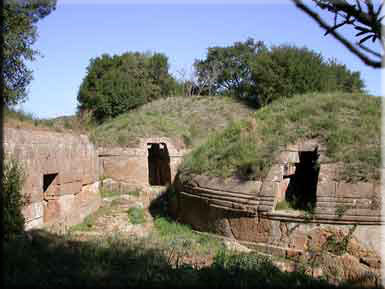
The Tomb of the Winged Demons of Sovana, discovery in the 2005, is the one of the most significant example of the tombs in the necropoli of Felceto in sovana. The tomb looks like a cubic block carved into the tufa, whose face is carved on the face of a building to a kiosk, characterized by a deep central room. Within this niche is represented a dead man lying in bed with a friendly libation in his right hand, which keeps intact the special polychrome finish. The sculpture preserves the covering of stucco and colors, red for exposed parts,  whitefor  tunic and mantle.

At the sides of the central niche originally stood two statues of winged female demons, of which only that on the left, with the torch, is quite well preserved. On the pediment, in high relief, stands a majestic, winged sea demons. In symmetrical positions, in front of the facade, were two sculptures in the round were placed on high podiums, only that on the left, depicting a lion, is fairly well conserved.


mercoledì 17 luglio 2013

Necropolis of the Banditaccia, (Cerveteri).

The most famous attraction of Cerveteri is the Necropoli della Banditaccia, which has been declared by UNESCO a World Heritage Site together with the necropoleis in Tarquinia. It covers an area of 400 ha, of which 10 ha can be visited, encompassing a total of 1,000 tombs often housed in characteristic mounds. It is the largest ancient necropolis in the Mediterranean area. The name Banditaccia comes from the leasing (bando) of areas of land to the Cerveteri population by the local landowners.
The tombs date from the 9th century BC (Villanovan culture) to the late Etruscan age (3rd century BC). The most ancient ones are in the shape of a pit, in which the ashes of the dead were housed; also simple potholes are present.
From the Etruscan period are two types of tombs: the mounds and the so-called "dice", the latter being simple square tombs built in long rows along "roads". The visitable area contains two such "roads", the Via dei Monti Ceriti and the Via dei Monti della Tolfa (6th century BC).
The mounds are circular structures, and the interiors, carved from the living rock, house a reconstruction of the house of the dead, including a corridor (dromos), a central hall and several rooms. Modern knowledge of Etruscan daily life is largely dependent on the numerous decorative details and finds from such tombs. The most famous of these mounds is the so-called Tomba dei Rilievi (Tomb of the Reliefs, 3rd century BC), identified from an inscription as belonging to one Matunas and provided with an exceptional series of frescoes, bas-reliefs and sculptures portraying a large series of contemporary life tools.
The most recent tombs date from the 3rd century BC. Some of them are marked by external cippi, which are cylindrical for men, and in the shape of a small house for women.

A large number of finds excavated at Cerveteri are in the National Etruscan Museum , with others in the Vatican Museums and many other museums around the world. Others, mainly pottery, are in the Archaeological Museum at Cerveteri itself.


giovedì 11 luglio 2013

The Sancturary of Portonaccio (Veii)

The site.

The site is a polytheistic temple complex erected in a cutting on the side of the hill on which the city wall of Veii towered over it then. One of the richest sources of Etruscan artifacts: pottery and other objects inscribed in Etruscan and terra cotta statuary and other decorative elements, it contained two main structures, one a sanctuary dedicated to the goddess Menerva(Etruscan spelling) and the other a temple that had statues of Turms, Hercle, Aplu (the Apollo of Veii) and Letun on the roof, which has come to be regarded as a temple of Apollo. Next to the temple of Apollo was a rectangular pool. A well provided water. The site has been left wooded, as it was in ancient times, when surrounded by a sacred grove.
The site was excavated in modern times by Massimo Pallottino in the 1940s and published decades later by the first and second generation of his students. The roof of the temple of Apollo has been restored on one side. It hangs over the site on a geometrical framework of steel rods. The sanctuary of Menerva is under roof nearby. Otherwise, only the foundation walls of the complex survive. In ancient times, it was surrounded by its own wall.


The sanctuary to Minerva.

The Portonaccio Sanctuary of Minerva was the first Tuscan–type, temple erected in Etruria (about 510 BC). The reconstruction proposed for it in 1993 by Giovanni Colonna together with Germano Foglia, presents a square 60 feet (18 m) construction on a low podium (about 18 metres, considering the 29 cm foundation) and divided into a pronapse with two columns making up the facade between entrances, 24 feet (7.3 m) deep and a group in the back made up of three 30 feet (9.1 m) deep adjacent cells. The 21-foot (6.4 m) columns were made of stuccoed tuff as were the walls, which inside the pronapse were decorated with various paintings on clay panels. The roof was in wood covered with polychrome terracotta. The terracotta was placed through a refined system of syllabic abbreviations and they were integrated with bronze inserts and a generous profusion of plastic inserts, mostly modelled by hand, among which a splendid series of grand antefixes (joint coverings) with the heads of Gorgons, maenads and satyrs.


The temple of Apulu.


This sanctuary, among the most ancient and venerated on all of Etruria, was outside of the city and a road leading from the city of Veio to the Tyrrhenian coast and the famous Veio saline mines ran through it. Its most ancient nucleus tied to the cult of the goddess Minerva and a small temple, a square altar, a portico and stairs from the road were built in about 530-530 BC in her honour. The three cell temple with the polychrome terracotta decorations was erected in about 510 BC in the western part of the sanctuary. Adjacent to the temple there was a great pool with a tunnel and a fence that enclosed the sacred woods. The temple was in honour of the god Apollo in his prophetic oracle aspect inspired after the Delphi model to which purification ceremonies were tied. Heracles, the hero made god dear to tyrants, and maybe also Jupiter, whose image we have to imagine on the central wall of the temple were tied to Apollo. By the middle of the 5th century BC, all interventions on the temple are concluded and it begins a slow decline while the structures sacred to Minerva are renovated on the eastern sector of the sanctuary. The starting up again of the cult worshipping Minerva, which continued also after the conquering of Veio by Rome (396 BC) is documented by a splendid series of votive statues of classic and late-classic style boys, such as the famous head, “Malavolta” as to indicate the important role of the goddess in the rituals of the passage from adolescence to adulthood that signalled the fundamental phases of the life of the members of the aristocratic families of Veio. In the 2nd century BC, the tuff mine that destroyed the central area of the sanctuary was opened causing damage to the temple and the sliding down of material downhill. The recovery of the fragments of the sanctuary determined the start up of excavations in 1914, which continued after the discovery of the famous statue of Apollo in 1916.


lunedì 1 luglio 2013

Ornamental fitting of the Tomb of the Duce (coming from Vetulonia)

The tomb of the Duce (leader) of Vetulonia is of the circular type: a circle of stones driven into the earth actually surrounded the area of the tomb, in which various graves are found. The abundant trousseau, which belongs to several burial places, was found distributed in four pits, while a fifth was found empty and is thought to have been looted. Some elements of the trousseau, currently kept in the storerooms of the Museo Archeologico Nazionale (National Archaeological Museum) of Florence, indicate that the founder of the family buried in this tomb was a warrior prince: this theory is supported above all by the discovery of the remains of a cart inside the first pit.

In another pit we find the probable name of the prince, Rachu Kakanas, preserved in the inscription on a fragment of a silver cup. Together with this fragment were discovered a magnificent bronze urn in the form of a hut covered in silver leaf (containing the remains of the cremated deceased) and a small ship in bronze of Sardinian production, decorated around the edges with little free-standing animals, which refers to the journey of the deceased towards l’Isola dei Beati (the Island of the Blessed). This nucleus of objects was completed by some brooches in gold, silver and elettro(an alloy of gold and silver) and some terracotta discs, a symbolic image of the military shield.

The last two pits housed abundant items for banquets in ceramics and bronze, some produced locally in Vetulonia, and others imported. Amongst the latter were found Siro-Cypriot pitchers and bowls and Greek earthenware, imported here thanks to the intervention of Cerveteri. Influences from central-North Europe are noted, on the other hand, in the largesitule (water buckets) in laminated bronze, local re-workings of models from the Hallstattiana culture (present-day Austria).


mercoledì 5 giugno 2013

Circle of Ivories of Marsiliana d'Albegna - Grosseto

The tomb is composed of a rectangular pit situated within a circle of stones embedded in the ground.

The three individuals interred inside were buried with rich funerary fittings that included fragments of a war chariot, a shield and iron spears.

From the designs made at the time of the discovery, it would seem that the central section can be related to a high-ranking personage, since the remains of the chariot and shield were arranged at his head and feet, whereas the spears were alongside another skeleton on his left.

On exhibit in the Museum of Archeology and Art of Maremma in Grosseto since March 1999, these burial fittings include some precious objects, collected inside a bronze basin, placed in an isolated corner of the pit. The tomb owes its name to the very valuable circle of ivories; one stands out in particular from amongst them: the scriptorium, composed of a small board with the alphabet engraved in the upper margin, styli and scrapers (used for etching and “cancelling” the signs written on the layer of wax that was spread on the board). In addition, there is a pyx with a grip on the cover in the shape of a lotus flower and decorated with figurative and zoomorphic designs in the manner of the oriental repertoire, some handles of flabelli (fans) decorated at the base of the handle with groups of plastics with two male figures fighting against a lion, and a comb ornamented with figures of animals (sphinxes, lions, griffons) deduced from the same repertoire of oriental origin. Alongside the ivories are some gold, silver and bronze fibulas as well as a rare funeral mask in silver laminate that reproduces the face of a bearded man.

The fittings date back to 670-640 B.C.


martedì 14 maggio 2013

Ornamental fitting of the Tomb of the Lictor (coming from Vetulonia - Grosseto)


This tomb takes its name from the lictor bundle (a bundle of rods with a two-edged hatchet in iron), found in the funeral trousseau. This immediately brings to mind the passage in which the Latin poet Silius Italicus stated that the city of Vetulonia would have passed on to Rome this symbol of supreme power.

From the tales of Isidoro Falchi, who discovered this tomb at the end of the nineteenth century, we learn that it was a circular tomb, defined by stones driven into the ground, and it presented a grave inside covered with stones and earth. On top of the filling of the grave lay the remains of a cart: the iron rims of the wheels are preserved, as are fragments of the bronze leaf which would have covered the parapet of the cart, decorated with figures of animals, braids, lotus flowers and palms in an oriental style.

In the grave, as well as weapons made of iron and an incense-jar in bronze of Vetulonian production, were placed sumptuous items of jewellery, maybe in a special container. We recall the large brooches decorated with designs of animals both real and mythical, made using the techniques of embossing and granulation, the brooch with a bow shaped like a sphinx and the hatpin with a spherical head, decorated using gold-dust with animal and vegetable motifs.

The objects from this trousseau are currently kept in the storerooms of the Museo Archeologico Nazionale (National Archaeological Museum) of Florence. 


lunedì 6 maggio 2013

Demaratus of Corinth


Demaratus was a nobleman of the House of Bacchus at Corinth. Facing charges of sedition, in 655 BC he fled to Italy, according to tradition settling in the Etruscan city of Tarquinii, where he married an Etruscan noblewoman. They had two sons, Lucius and Arruns.

According to tradition, Demaratus introduced Greek culture to mainland Italy, and brought potters from Corinth; Greek potters worked at Tarquinii and its port, Gravisca. Tacitus reported that Demaratus brought literacy to the Etruscans.

Through his sons, Demaratus was the ancestor of the Roman gens Tarquinia. Arruns Tarquinius died shortly before his father, leaving his wife pregnant. As Demaratus knew nothing of his future grandson, he left him no inheritance. For this reason the child, likewise named Arruns, was born into poverty, and called Egerius, meaning "the needy one."

As the son of a foreigner, Lucius Tarquinius was unable to attain high station at Tarquinii, despite his wealth and the nobility of both his mother and his wife, Tanaquil. With Tanaquil's encouragement, he migrated to Rome, where he won the favour of the king, Ancus Marcius. When Marcius died, Tarquin succeeded him to the throne.

Lucius Tarquinius was the father or grandfather of Lucius Tarquinius Superbus, the seventh and last King of Rome. He was also the father-in-law of Servius Tullius, the sixth King of Rome, who reigned between the two Tarquins.