header

mercoledì 18 settembre 2013

Fortified Settlement of Ghiaccioforte - 3 - Votive Offering

The discovery of votive offerings on the western hill of Ghiaccioforte testifies to the existence of a place of worship. In fact, it was an ancient custom to leave votive offerings near a sanctuary, which steadily accumulated.

The objects retrieved in the cache of votive offerings of Ghiaccioforte, preserved in the museum of Scansano, are mostly reproductions of parts of human anatomies, placed there to ask the divinity for the healing of an illness, or as thanks for a past healing.

The presence of two bronze statuettes, representing youths grasping a billhook, offers some indication of the kind of worship practiced in this place: it was probably connected to the agricultural activities of the area, as the iconography of the two statuettes would lead us to believe; they probably represent Selvans, typical Etruscan rural gods.


giovedì 5 settembre 2013

Fortified Settlement of Ghiaccioforte - 2 (Scansano - Gr)

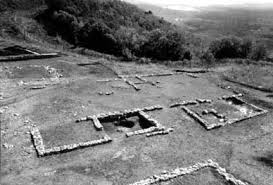
The settlement was built up within the city walls: some spaces were brought to light that made up part of the only living complex, where rooms were distributed around an open-air courtyard.

At the present time, all that is visible is the skirting foundations of the walls formed by a plinth of calcareous rock, while the raised portion, none of which has been preserved, was probably made of unbaked clay.

The floor was made of simple beaten earth or pebbles, whereas the roof was made of bricks and tiles as proven by the fragments of bricks recovered.

Based on the objects found inside, the various functions of some rooms can be identified.

In particular, the finding of an oven, derived from half of a dolium, cut vertically and placed on the ground, and the presence of a cooker, inserted into a niche dug into the inner wall, leads us to believe that the room, from whence these objects came, was used as a kitchen.

The corner of the bath can be identified by the furnishings composed of a terracotta basin and a bathtub derived from a block of decorated stone, both of which are preserved in the museum of Scansano.

In order to construct the tub, a copy of which can still be seen on site, an altar coming from the area of worship was probably reused; the area of worship presumably rose here in antiquity before the settlement of the Roman era.

One space, which was isolated to date with respect to the others, contained large doliums used for preserving foodstuffs: thus, its function was most likely that of a pantry.

The settlement restored many finds in ceramic: crockery and glassware for use at table and containers for preserving food. In addition, the presence of tongs, perhaps from a forger, and finished products, like weapons, indicate local metallurgical manufacturing.

martedì 3 settembre 2013

Fortified Settlement of Ghiaccioforte (Scansano - Gr)

Established in the 4th century B.C., the fortified settlement of Ghiaccioforte rose in the valley of Albegna, in the territory controlled by the ancient Etruscan city of Vulci.

The place chosen probably hosted a sanctuary, in antiquity, and previous settlers were housed in the homes scattered on the surrounding hills.

Its position was strategically placed for controlling and defending the Vulci territory in an era in which the pressure from Rome was becoming increasingly forceful in a general climate of political instability.

The end of the settlement of Ghiaccioforte was ultimately marked by the Roman conquest of the Etruscan city of Vulci and its surroundings in 280 B.C.

Once having settled there, the conquerors proceeded to reorganise the territory: new cities were built, such as Cosa (Ansedonia), but pre-existing sites, such as Saturnia and the settlement of Ghiaccioforte were also destroyed; the latter was never reconstructed. After the destruction, the location was intermittently inhabited, while the settling of new Roman farms changed the landscape of the surrounding hills.

Having been deserted and no longer occupied by a stable settlement, the environs reverted to pastureland over time. The name given to it today probably alludes to the destroyed fortified centre and the use the location had thereafter: ghiaccio from "addiaccio" (pen – shelter for the herd at night) and forte (fort) to indicate the remains of the Etruscan walls that never completely disappeared from view.


venerdì 9 agosto 2013

Tomb of the Winged Demons in Sovana

The Tomb of the Winged Demons of Sovana, discovery in the 2005, is the one of the most significant example of the tombs in the necropoli of Felceto in sovana. The tomb looks like a cubic block carved into the tufa, whose face is carved on the face of a building to a kiosk, characterized by a deep central room. Within this niche is represented a dead man lying in bed with a friendly libation in his right hand, which keeps intact the special polychrome finish. The sculpture preserves the covering of stucco and colors, red for exposed parts,  whitefor  tunic and mantle.

At the sides of the central niche originally stood two statues of winged female demons, of which only that on the left, with the torch, is quite well preserved. On the pediment, in high relief, stands a majestic, winged sea demons. In symmetrical positions, in front of the facade, were two sculptures in the round were placed on high podiums, only that on the left, depicting a lion, is fairly well conserved.


mercoledì 17 luglio 2013

Necropolis of the Banditaccia, (Cerveteri).

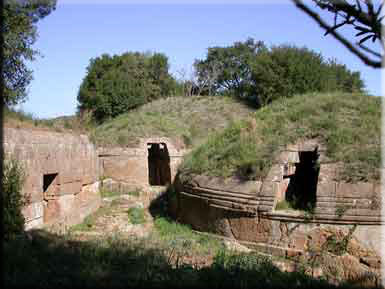
The most famous attraction of Cerveteri is the Necropoli della Banditaccia, which has been declared by UNESCO a World Heritage Site together with the necropoleis in Tarquinia. It covers an area of 400 ha, of which 10 ha can be visited, encompassing a total of 1,000 tombs often housed in characteristic mounds. It is the largest ancient necropolis in the Mediterranean area. The name Banditaccia comes from the leasing (bando) of areas of land to the Cerveteri population by the local landowners.
The tombs date from the 9th century BC (Villanovan culture) to the late Etruscan age (3rd century BC). The most ancient ones are in the shape of a pit, in which the ashes of the dead were housed; also simple potholes are present.
From the Etruscan period are two types of tombs: the mounds and the so-called "dice", the latter being simple square tombs built in long rows along "roads". The visitable area contains two such "roads", the Via dei Monti Ceriti and the Via dei Monti della Tolfa (6th century BC).
The mounds are circular structures, and the interiors, carved from the living rock, house a reconstruction of the house of the dead, including a corridor (dromos), a central hall and several rooms. Modern knowledge of Etruscan daily life is largely dependent on the numerous decorative details and finds from such tombs. The most famous of these mounds is the so-called Tomba dei Rilievi (Tomb of the Reliefs, 3rd century BC), identified from an inscription as belonging to one Matunas and provided with an exceptional series of frescoes, bas-reliefs and sculptures portraying a large series of contemporary life tools.
The most recent tombs date from the 3rd century BC. Some of them are marked by external cippi, which are cylindrical for men, and in the shape of a small house for women.

A large number of finds excavated at Cerveteri are in the National Etruscan Museum , with others in the Vatican Museums and many other museums around the world. Others, mainly pottery, are in the Archaeological Museum at Cerveteri itself.


giovedì 11 luglio 2013

The Sancturary of Portonaccio (Veii)

The site.

The site is a polytheistic temple complex erected in a cutting on the side of the hill on which the city wall of Veii towered over it then. One of the richest sources of Etruscan artifacts: pottery and other objects inscribed in Etruscan and terra cotta statuary and other decorative elements, it contained two main structures, one a sanctuary dedicated to the goddess Menerva(Etruscan spelling) and the other a temple that had statues of Turms, Hercle, Aplu (the Apollo of Veii) and Letun on the roof, which has come to be regarded as a temple of Apollo. Next to the temple of Apollo was a rectangular pool. A well provided water. The site has been left wooded, as it was in ancient times, when surrounded by a sacred grove.
The site was excavated in modern times by Massimo Pallottino in the 1940s and published decades later by the first and second generation of his students. The roof of the temple of Apollo has been restored on one side. It hangs over the site on a geometrical framework of steel rods. The sanctuary of Menerva is under roof nearby. Otherwise, only the foundation walls of the complex survive. In ancient times, it was surrounded by its own wall.


The sanctuary to Minerva.

The Portonaccio Sanctuary of Minerva was the first Tuscan–type, temple erected in Etruria (about 510 BC). The reconstruction proposed for it in 1993 by Giovanni Colonna together with Germano Foglia, presents a square 60 feet (18 m) construction on a low podium (about 18 metres, considering the 29 cm foundation) and divided into a pronapse with two columns making up the facade between entrances, 24 feet (7.3 m) deep and a group in the back made up of three 30 feet (9.1 m) deep adjacent cells. The 21-foot (6.4 m) columns were made of stuccoed tuff as were the walls, which inside the pronapse were decorated with various paintings on clay panels. The roof was in wood covered with polychrome terracotta. The terracotta was placed through a refined system of syllabic abbreviations and they were integrated with bronze inserts and a generous profusion of plastic inserts, mostly modelled by hand, among which a splendid series of grand antefixes (joint coverings) with the heads of Gorgons, maenads and satyrs.


The temple of Apulu.


This sanctuary, among the most ancient and venerated on all of Etruria, was outside of the city and a road leading from the city of Veio to the Tyrrhenian coast and the famous Veio saline mines ran through it. Its most ancient nucleus tied to the cult of the goddess Minerva and a small temple, a square altar, a portico and stairs from the road were built in about 530-530 BC in her honour. The three cell temple with the polychrome terracotta decorations was erected in about 510 BC in the western part of the sanctuary. Adjacent to the temple there was a great pool with a tunnel and a fence that enclosed the sacred woods. The temple was in honour of the god Apollo in his prophetic oracle aspect inspired after the Delphi model to which purification ceremonies were tied. Heracles, the hero made god dear to tyrants, and maybe also Jupiter, whose image we have to imagine on the central wall of the temple were tied to Apollo. By the middle of the 5th century BC, all interventions on the temple are concluded and it begins a slow decline while the structures sacred to Minerva are renovated on the eastern sector of the sanctuary. The starting up again of the cult worshipping Minerva, which continued also after the conquering of Veio by Rome (396 BC) is documented by a splendid series of votive statues of classic and late-classic style boys, such as the famous head, “Malavolta” as to indicate the important role of the goddess in the rituals of the passage from adolescence to adulthood that signalled the fundamental phases of the life of the members of the aristocratic families of Veio. In the 2nd century BC, the tuff mine that destroyed the central area of the sanctuary was opened causing damage to the temple and the sliding down of material downhill. The recovery of the fragments of the sanctuary determined the start up of excavations in 1914, which continued after the discovery of the famous statue of Apollo in 1916.


lunedì 1 luglio 2013

Ornamental fitting of the Tomb of the Duce (coming from Vetulonia)

The tomb of the Duce (leader) of Vetulonia is of the circular type: a circle of stones driven into the earth actually surrounded the area of the tomb, in which various graves are found. The abundant trousseau, which belongs to several burial places, was found distributed in four pits, while a fifth was found empty and is thought to have been looted. Some elements of the trousseau, currently kept in the storerooms of the Museo Archeologico Nazionale (National Archaeological Museum) of Florence, indicate that the founder of the family buried in this tomb was a warrior prince: this theory is supported above all by the discovery of the remains of a cart inside the first pit.

In another pit we find the probable name of the prince, Rachu Kakanas, preserved in the inscription on a fragment of a silver cup. Together with this fragment were discovered a magnificent bronze urn in the form of a hut covered in silver leaf (containing the remains of the cremated deceased) and a small ship in bronze of Sardinian production, decorated around the edges with little free-standing animals, which refers to the journey of the deceased towards l’Isola dei Beati (the Island of the Blessed). This nucleus of objects was completed by some brooches in gold, silver and elettro(an alloy of gold and silver) and some terracotta discs, a symbolic image of the military shield.

The last two pits housed abundant items for banquets in ceramics and bronze, some produced locally in Vetulonia, and others imported. Amongst the latter were found Siro-Cypriot pitchers and bowls and Greek earthenware, imported here thanks to the intervention of Cerveteri. Influences from central-North Europe are noted, on the other hand, in the largesitule (water buckets) in laminated bronze, local re-workings of models from the Hallstattiana culture (present-day Austria).